|
| It Begins Here, But First A Story |
 |
| Listen to the Marsh Birds Sing in the Pines |
 |
| Honk! Honk! Traffic Increases |
 |
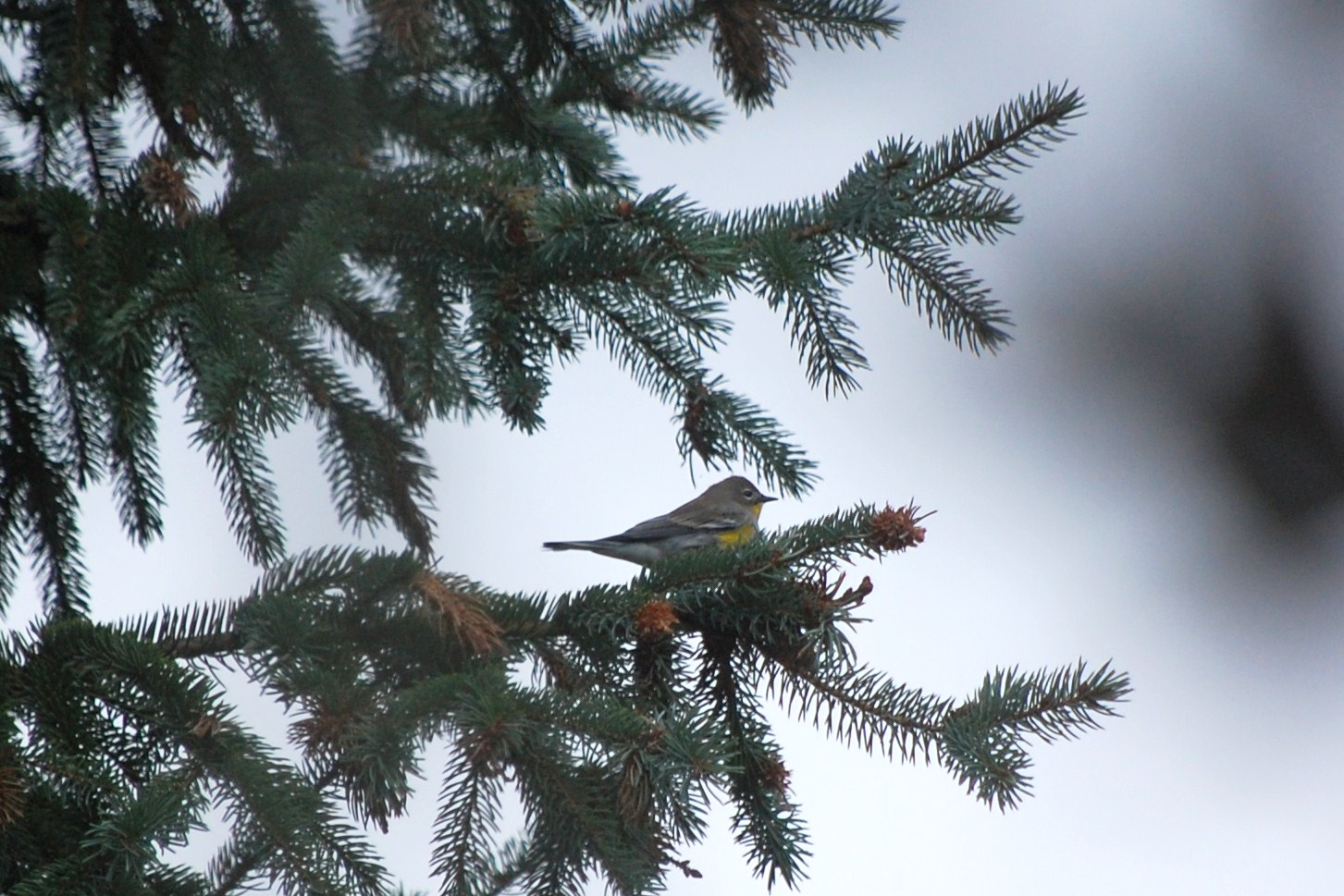
| Yellow Rumped Warbler with Other Yellow Patches |
 |
| Pink & Streaked Cassin's Finch |
 |
| Lady Cassin Sports No Colors |
 |
| Osprey & Falcon Country |
 |
| Talkative Osprey on Nest |
 |
| Silent Hay Bales in Field |
 |
| American Kestrel Watching Us Watch Him |
 |
| Portapotty is Not That Portable |
 |
| American Kestrel on an Idaho Fencepost |
 |
| My Miserable Missed Shot of a Downy Wood Pecker |
 |
| Perfectly Posed Pecker, Photo by Mr. Mills...Grrr... |
There is a purpose to the title beyond shock value.
In
part, it gives an opening to my opinion on media titles these days.
Titles attract attention, but have you noticed the
popular ones online follow the formula of arousing curiosity? Titles
like, "What She Found Was Shocking" or "He Opened the Door and Then Did
This." We're suckers for satisfying our curiosity. Stick with me and
I'll satisfy yours with a photo.
Curiosity gets me up in the mornings. What's all that ruckus?
I step outside and hear bird chatter louder than it has been since the
robins returned to the 'hood
in February. It's commuter traffic -- the avian migration has begun.
Geese honk on the pond, red-winged blackbirds zip around one another to
race through pine boughs and new birds turn my head as if they were show
cars.
I snap shots and post some on a bird group
online to ask, "What's this?" My favorite game with geologists has
evolved into a new version with the backyard bird-watching experts. With
suggestions I go to my field guides or ones online like the Cornell Lab
of Ornithology's
All About Birds.
Last
Saturday a group of cedar waxwings arrived and left before I could grab
photo evidence. Two days ago the chickadees showed up with
yellow-patched friends. I got good shots and a woman online suggested it
was a yellow-rumped warbler. I never did see his rump, but turns out
the yellow patches, streaks and white eye ring are indicative of the
western version -- Audubon's warbler.
It sounds so prestigious around here during fall migration.
I'm
sitting in my lawn chair, properly perched upon my lawn, staring at the
blue spruce that towers above my garden. Coffee in one hand, camera in
the other, I'm waiting to see the finch I saw from my upstairs window.
The bird that got me curious enough to drink outside this morning.
Bootsy meows all the way from the garage kitty door to my side. Shhh...
And
he lands. It must be male because he has color. In the spring all the
migrating male ducks are easy to tell apart and when they leave I
struggle to identify their ladies who all wear similar attire as if they
are part of some commune. Beaks and size help, and I can tell dabblers
from divers, but those ladies all like to wear nondescript browns. This
fella has pink.
He's definitely a finch -- look at that
beak. He's not dark red like a purple finch or house finch. His pink
hues and streaking mark him a Cassin's finch. His crown is no longer
prominent. That's one way males differ in the fall from the spring.
When it's mating season they plump up their best colors and chirp,
"Hey, Baby..." By fall, they're trying to look incognito, "That wasn't
me, Baby, I don't have any fledglings..."
Migrations
bring all sorts together. Different birds of different genders and ages
all gather. There's safety in numbers. In between cup number one and cup
number two, a white breasted hawk attempts to grab at a bird in the
pines. Incensed male red-wings chase him off. By the time I get the cup
set aside and the cat off my lap, the predator has flapped away.
Before the migration began, Todd wanted to show me...no, we aren't at the title yet!
What
he wanted to show me was the valley that had osprey and his favorite
falcons, American kestrels. He delivered a new route for Fed Ex before
they unceremoniously texted him last Saturday that they had no more work
for him. Work has a way of migrating from small western towns this time
of year, too.
We drove along the south flank of Pend
Oreille River before it turns north at Newport, Washington. The drive
was full of osprey nests and we found kestrels where he had regularly
seen them. In between old ranches and modern hay fields, we snapped
photos, both of us armed with Nikons.
He took me to a
small lake with a portapotty chained to a tree. It must be the seasonal
bathroom for those coming to the lake to fish. No birds were around, but
mid-day is not the best viewing time on waterways. We peed, we looked,
we left.
Further down the road Todd drove me through an
interesting outcrop of houses. Each one was fenced with "Beware of Dog"
signs. Unsettling when you are a delivery driver. His short time on
that route he got nipped twice, once even breaking the skin. He wanted
to show me some mules. They don't bite.
As we were
admiring the mules, a flash of red caught our attention. Todd is just as
curious as I am when it comes to critters and birds and we often tease
the other if only one of us has a sighting, "I didn't see it, so it
didn't exist." Tops on our list of things that didn't exist was the
wolverine that crossed the road as I drove and he slept.
This day it was a downy wood pecker.
Excited
we both aimed our cameras. My fussy telephoto took time to focus. The
bird hopped in and out of view, such an elusive bird to capture in
pixels. He snapped his shot, set the camera down and drove off. In
losing my focus, I lost my shot. He still gloats that HE got the good
picture.
And all I got was an attitude of pecker envy.