Showing posts with label pond. Show all posts

Thursday, March 5, 2015

Awakened

Geese On Remaining Ice
Ice So Thin It Should Be Water
Blue Heron Returns
Blue Heron Toes on Ice
Naughty Bird Dog
Temporary Bird Watching Post
A Hero's Cape of Feathers
New Bird Watching Buddy
Preening Feathers
Hunting Mice
Wading Through the Dried Grass
Birds Unruffled by the Cat
Sun coaxes my eyes to open, but I ignore the persistent rays. Do I long for the rainy season because northern Idaho needs the moisture or because dark clouds can hide the undeniable fact that the sun is rising earlier each morning?

The chilly non-precipitous days continue and diminish my desire to roll out of my snug and warm bed. Even Bobo looks at me with one eye open as if to say, "Forget it." Waking up ranks low on my favorite daily tasks. No matter the time, I'm never a morning person.

With Grenny on a leash and Bobo unfettered, I stagger outside in Todd's boots only because he leaves his shoes scattered like toys at the porch door. Mine are neatly sequestered upstairs where I always forget them. My brain is still groggy.

A Canada goose couple hold my attention. They give me the morning pond report: ice remains. It seems thin as silver paint flakes and I wonder how two large water birds that can weigh as much as 18 pounds each can stand sturdily on a skim of ice. Maybe it's the webbed feet.

Then I see him and I'm fully awakened. My returning hero, my knight in blue feathers, Blue Heron.

Bobo spies him, too and to my horror, she gives chase. I never allow the dogs pond access once migration returns and breeding commences. Blue Heron tucks long legs and glides across the pond with a few flaps of wings as blue as steel and spanning almost six feet across.

This is a much bigger bird than a pointer can manage. I call and Bobo returns to me.

Blue herons in general can cruise at 20 to 30 miles per hour with those wings. In summer, they are easy to spot, cruising low through the valley from bog ponds to lakes or rivers. Elmira Pond has one resident Blue Heron and he's back! He stays, but avoids the annoyance of the dog by scooting to the far side of the pond.

Long legs are for wading. But there's little open water on Elmira Pond this morning. It's March 5 and last year I welcomed my returning hero on March 29. That he is so early, I'm taken by surprise. What will he do with the skim of ice? The geese at least can munch on pasture grass.

After returning the dogs to the house, I grab my coffee mug, camera and plastic chair. Usually I don't dare so close a view of Elmira Pond, wanting the residents to feel secure, but Blue Heron is on the other side and mating ducks are not yet here. The geese are not easily deterred so I take the rare opportunity to settle a seat so close to the pond.

And then I hear loud meowing. Bootsy has followed me. I watch her approach and figure her voice is giving fair warning to all birds present, including the robins. No feathers seem ruffled and the cat hops onto my lap. How strange it is to be watching birds in the companionship of a cat.

The peat is yet young and greening; clover miniscule and green grass hidden beneath matted humps of last year's crop. My coffee is settled on a mound of peat and my toes wiggle in Todd's boots. Blue Heron is back!

I watch him through the lens of my Nikon, the camera body squishes the tip of my nose and I tuck my elbows in for support. I hold the position. He preens his feathers like a guest who wants a shower after a long trip.

How long? Maybe he just stayed in central Washington. Maybe he went to Arizona. Maybe he's been hanging out along the open waters of the Clark Fork River.

Blue Heron swings his blade-face around and cocks an eye my direction. He coils his neck like a striking snake and I'm surprised to see him in a hunting stance. Like a warrior with a lance, he strikes and returns to a fully upright position, neck elongated and beak holding what looks like a mouse.

Evidently, my wading bird is content to eat mice until he can reach the fish. In another month or two the bull frogs will spawn and he will feast. For now, the feast is all mine and I digest the view before me with eyes fully awakened.

Elmira Pond returns to life.

Haiku to a Heron

Common predator
of field mice, fat fish and frogs.
Lancelot has returned.


Tuesday, August 5, 2014

Ranch Royalty

Do You Know This Joke?
Ranch King, Indeed
Cupping Wind
Fledgling in the Pine
Ranch Royalty
The Fly-Catcher & The Horse
Normal rhythms feel comforting. But rhythms are dynamic--the same song does not play over and over.

There's always new music to take its place.

It's sunny, pleasant and dry. The basking log holds three companions this morning, aligned across the gray wood. It makes me think of a joke, "So a turtle, merganser and mallard walk into a bar..." Only, I don't know the punchline, so I contend myself with watching.

The king bird is pipping noisily this morning, hawking insects as I sip coffee. Sometimes, on warm days like this, I like to go for a drive with the windows rolled down, arm extended outside and hand cupped so it glides over the moving air.

That is how the king bird flies--like a feathered hand cupped over pockets of air, flapping to make his own speed. He flies past the gate and I notice the brand reads, "Ranch King." How appropriate. For now, he carries the title.

But often, as is the way with me and birds, I'm mistaken. "He" might be "she." Part of the colorful pipping this morning is because there are two king birds. One has stepped out onto the swinging branch of a towering ponderosa by the horse barn. It might be a fledgeling.

Eventually, the second bird in the pine drops down to the hanging electrical wire that crosses the pasture to give light to the barn.

Side by side the two sit as one feeds the other caught insects. that seems like a motherly act, though father's can feed young ones too, but the kids always seem to prefer mama's cooking.

The queen version of the king bird, flits off and lands on the wooden fence posts. She (or he) seems regal as the horses wander by, munching and moving, flipping long tails at flies no doubt this bird would like to eat.

Please do. And eat some mosquitoes while you are at it, my Ranch Royalty.

Saturday, April 19, 2014

Day of Reflection

Basking Turtles and Ring-Necked Couple
Busy Day on the Pond
Bufflehead Female
Semi-Inflated Hooded Merganser
Yes! Lady Merganser Has Arrived
Pacific northwest cloud cover, wispy and white nearly hides the blue sky. You can see a tinge of blue as if looking at a robin's egg behind thin cotton. Days like this turn Elmira Pond green.

Not green, as in dingy pond-scum green. This clear water bog pond, peat pond, spring pond, mountain valley pond is many things, but never scummy. Today it is green because of cloud cover. With the blue sky blocked, Elmira Pond reflects the green of the Ponderosa pines.

It's a day of reflection. All six painted turtles line the log with mirror images belly-up to the sky. Basking may not be sunny today, but it is warmer and no longer drizzling. A ringed-neck duck couple joins the turtles in basking.

It's a busy day on the pond. Although the American wigeons vacated over a week ago, the knuckle-headed buffleheads that had courted upon these reflective waters left behind their gal. I noticed the female duck, recognizing her white cheek-patch. Like the mergansers, she roosts and nests in trees.

I'm beginning to understand where ducks go at night.

The hooded merganser inflates and deflates his head while I swill coffee, admiring his colorful pond reflection. I'm delighted to confirm that he indeed has a lady. She's the one doing all the silly head-bobbing, wing flapping and preening that the male buffleheads do. The male floats nearby, puffing his crest.

All are diving, but the geese. The big dabblers are pulling up chunks of submerged plants. Fish or frogs rise dangerously close to divers. I've yet to see a merganser swallow a frog or fish whole this season, but I know they do.

As if in absence of blue, Blue Heron remains unseen. Yesterday he showed up briefly with a companion. I'm hopeful that he may yet raise a family this summer.

Another cup of coffee down and my reflections come to a close.

Friday, April 4, 2014

Friday Morning Rain

Mist Shrouds the Mountain Tops
Pastures Hide Killdeer and Blue Heron
Morning Traffic in the Rain
Wigeons Don't Mind the Wet and Wind
Snow Up High
Turtle Log
Abandoned Pond Nest in Winter
Mist shrouds the tops of mountains as rain drizzles on Elmira Pond. The wind gusts with that hollow window howl that makes me want to curl up beneath a velvety blanket with a good book. It's chilly, but not enough for a fire, yet when the winds whirl mist off the mountains I can see that it's snowing in the higher elevations.

A killdeer is my morning tease. I can hear her shrill cry above the wind at my window, but I can't see her. I look with bare eyes and binoculars. Scanning the pasture, the pond's eastern edge and the overgrown dead grass of the Bluebird Ranch I don't glimpse her movement or flash of white underparts. But she continues to shrill, kill-deeah-dee-dee.

Other than the wind there seems to be no obvious threat to the killdeer's cry. Maybe she's just as bad at singing as I am and only sounds distressed. While I can't see her, I know she's plucking insects from the pastures. It's the favorite food this time of year and I welcome the diners.

Because we run horses here in the summer, our pastures look like they have a winter buzz cut. Fuzzy green new growth is barely showing. It will be another month before there's enough grass for the horses and by then the killdeer babies will have hatched. If there's a nest.

The birds of Elmira Pond are crafty at hiding their nests. This past winter, I stumbled across several of them, amazed that they even existed. The winter winds gusted other nests out of tall pines. Nests can be rebuilt; the builders are good at what they do. I just supply the materials--grass, mud, sticks and even loose strands of my own hair that I toss to the wind, "for the birds."

Blue heron stands across the pond from all the killdeer chatter. Between my vantage point and his, wigeons and geese float in the rain. Birds don't seem to mind. Already there are frogs on the pond--I started to hear peepers this week. At night, I step outside and peepers fill the night with calls. I know when a predator invades Elmira Pond because the peepers go silent. It's eerie when they do. So I feel safe out in the dark when I can hear them.

But this morning, they are potential breakfast. Blue Heron patiently waits like I do, standing still, waiting for that final percolation of the coffee pot. Then I dive in, filling my mug, savoring the heat and aroma as if it were my first taste after a long migratory flight.

The exposed log in the pond--alternately it is the basking spot for many--holds five turtles this morning. I wonder what rain on turtle-shell sounds like and if the turtles enjoy the drumming as much as I do when it pummels the metal roof of my house. Soothing, rhythmic sounds to accompany the wind.

Thursday, April 3, 2014

Peeps on the Pond

Wigeons Cluster in the Distant Pool
Wigeons Visit the Trenches
Powerful Dabblers
Flirty Male
Tails to the Morning Sun
Oops...I Don't Think She's Looking at His Display
Wigeons and Goose
Hungry for More Than Pond Plants
Standing still I cock my head like the dogs do to hear better.

Peep-peep-peep...it's the wigeons. Even before I read about the American wigeon on the Cornell Lab of Ornithology's website, I decided that this Elmira Pond visitor sounded like a squeaky toy. And that is exactly how the experts describe the whistle of a wigeon.

I like to think of them as my "peeps."

Wigeons are among the first to arrive on Elmira Pond following the ice melt. Northern Idaho is their most southern border for breeding grounds. Author, Randall St. Germain who lives further north in Canada, has impressive close-up shots of Ducks on Ice on his blog, including American wigeons.

With a white stripe and green head patch, male wigeons are also wooing their ladies with tail wags, water hops and wing flapping. Among the whistling peeps I see water dances and splashes from the western side of the pond.

More skittish than the bold little buffleheads, wigeons cluster in a group and stay far across the pond. Just a few mornings ago I watched the entire group flap into flight, circling like a small feathered whirlwind. What looks like six or eight wigeons on the pond materializes into twice that number in the air.

An eagle gliding low over the valley spooked them into flight. Eagles hunt ducks. Soon the danger passed and wigeons returned to flutter and dabble in their favorite far pool.

One amorous and hungry wigeon couple is swimming up an old peat trench. If you look carefully at Elmira Pond, you can see several squared swaths dug out of the east shoreline where peat miners harvested the bog matter to sell. I don't know much about the process but I do know that it takes hundreds, even thousands of years to build up peat in a bog.

That speaks volumes of Elmira Pond's age.

Mining seemed minimal in former years, yet the swaths remain as trenches favored by the Canada goose couple. Of course, that pair is fearless--former hockey players--so they don't mind swimming and dabbling so close to the house. But I'm surprised to see a wigeon couple.

Up close the male's green head patch glistens with iridescence, the color of a mallard's. They dabble powerfully, almost diving straight down as they tip, tails to the morning sun. They bounce like a bobber with a fish on the line, going after aquatic plants with gusto. The male flutters his wings in between feeding, letting the female know that's he's interested in more than food.

Such is spring on the pond with peeps.

Monday, March 31, 2014

Knuckleheads

Pond Gets Busy
Tiny Ducks, Big Heads
Female Has a White Cheek
"Hey, Baby..."
Hooded Merganser and Bufflehead (Both Males)
Smallest Ducks on the Pond
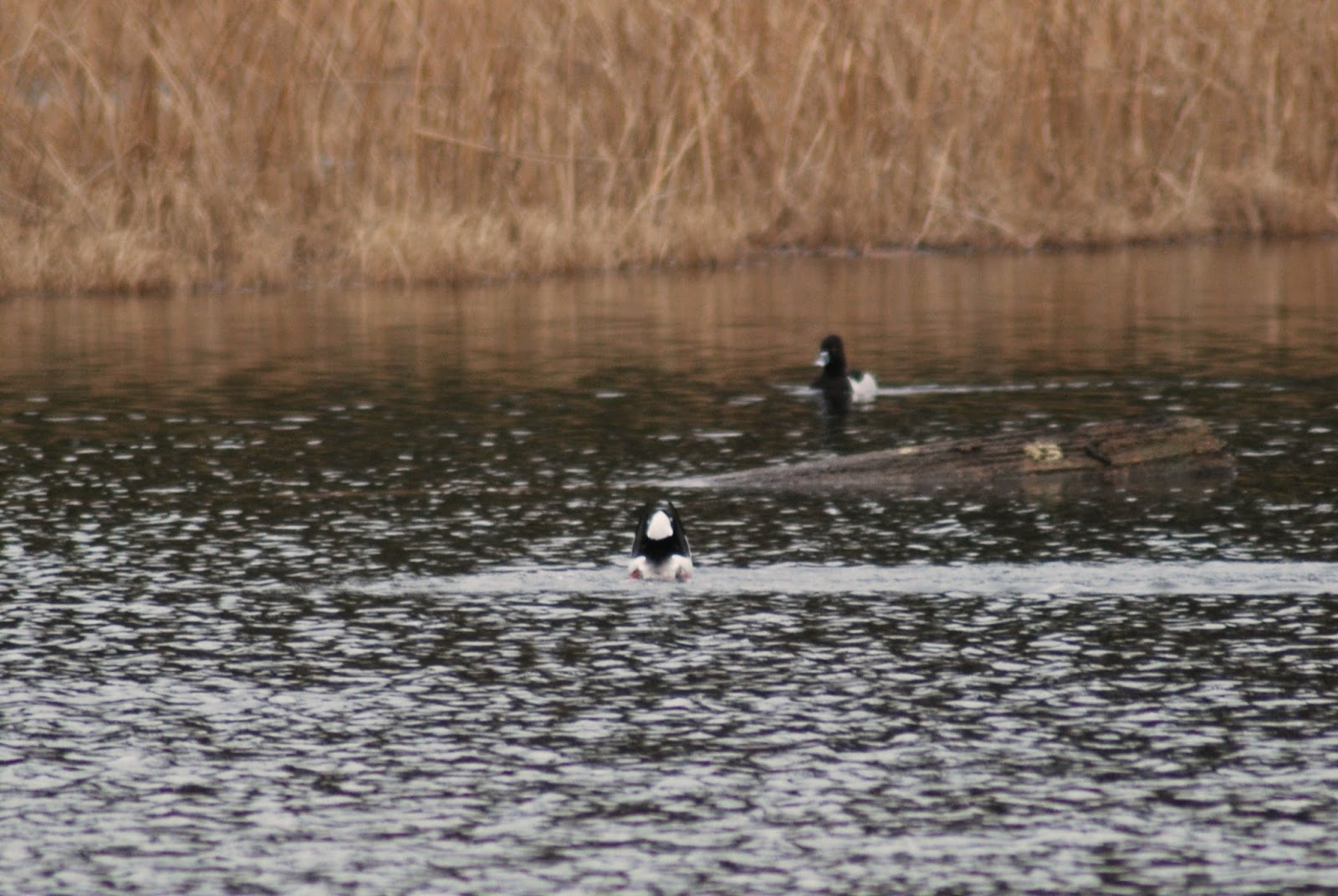
Buffleheads bob on Elmira Pond.

The ice is gone and the ducks have returned. Blue Heron came back and I swooned, even writing him a poem. I never write poems. Call me unstable at the moment--I have bird fever. I'm pondering where to put up ladders to improve my view of the ducks and tromping all over the horse pastures with camera, binoculars, bird books and coffee.

I'm giddy and may need a straight-jacket by the end of the week if I keep this up.

Texting duck updates to my daughter, auto-correct changes "buffleheads" to "knuckleheads." At the moment, the latter might be appropriate. The buffleheads are acting foolish, like grown cowboys in a bar when a lone female sashays into the joint. Three male buffleheads and one little female just bellied up the pond.

It's like the ducks are grunting the universal phrase for, "Hey, Baby..."

Buffleheads are so named because they are a little duck with a great head like a buffalo. The males are the whitest duck you'll see on water, but they have a blackish-purple head with a large white patch extending from eyes to crown. The female is a blotchy dark gray duck with a white cheek patch.

She may not be hot by glamor standards, but she has these males acting like smitten knuckleheads.

In courtship, the males bob those big heads. They all swim near the female, head-bobbing like duck rappers. Their music is a loud chattering. They're divers, and one male keeps diving beneath the female like he's trying to see up her skirt. The males rear up on water, skittering half in flight, half running. They charge at her, at each other and even at the lone hooded merganser who's like, "Hey, I'm waiting for my own chick to show up. Back off."

What's even more outrageous than what's happening on the pond is my mania to watch it. I cross the horse pasture and prop my camera on the corner fence post. Standing next to a pile of deer poop, I shoot pictures like a paparazzi having discovered Madonna and three boyfriends on a secluded beach. I giggle (I do this a lot during bird season) and click pictures of the knuckleheads on Elmira Pond.

Enjoy the peep show: