Showing posts with label hooded merganser. Show all posts

Wednesday, March 9, 2016

Magnificent Eight

On a Misty Morning the First Mergansers Arrive
The Hawk Likes the Pond Food, Too
A Female Checking Out the 'Hood
A Couple of Flashy Males
Where Mergansers and Horses Meet
Grenny Scored a Gopher! Todd Carries the Trophy
Party on the Water
Males Flash and Splash
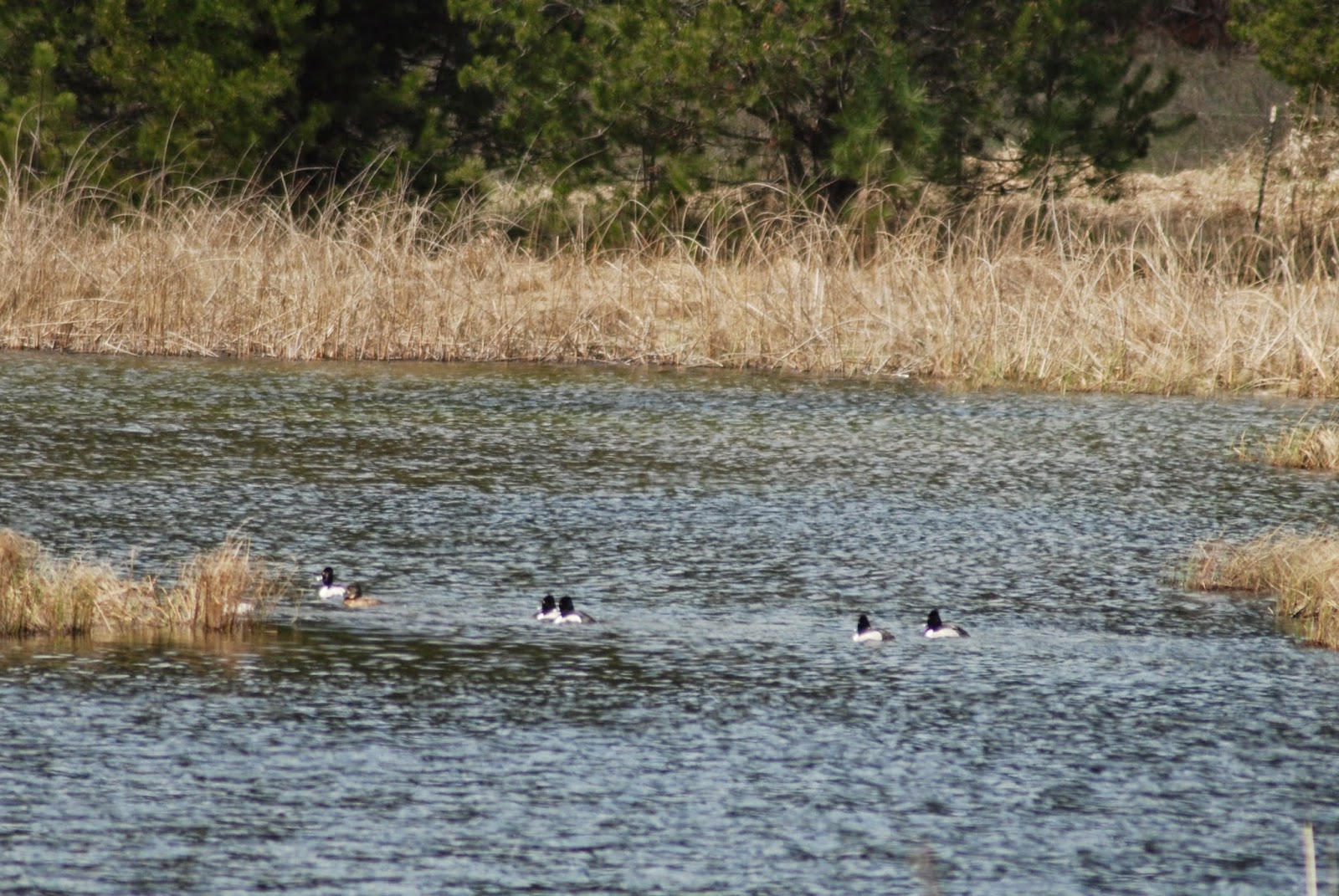
White catches my eye easily. It flashes like a beacon from Elmira Pond, and that's exactly what it is -- a neon sign for sex. The Magnificent Eight have arrived.

Male mergansers in full mating regalia are hot to behold. At least, I hope females flying overhead in the great northern migration think so. How can the ladies miss all those flashing inflated white heads on one pond?

Perhaps they long for more than a healthy hood in a male.

Do prospecting female mergansers consider the neighborhood? After all, these flashy males promise to abandon them when junior mergansers arrive. The males deflate their hoods and move out.

The females school the juveniles in the art of fishing and eagle avoidance.

So while the males are partying in March on Elmira Pond, singing, "Hey baby, hey baby, hey..." and dancing on water with wings splayed and waves kicked up into a crest, the females are looking beyond the boys and at the 'hood.

The Purcell Trench cradles Elmira Pond in a swath of glaciated land. In comparison to the massive bodies of water left behind by glaciers -- Lake Pend Oreille, Kootenai  River, Priest Lake, the Clark Fork -- it is humble. "Bog" is often the name it receives.

Yet, the water deserves at least pond status. It might be spring fed or merely left-over glacial drainage. It has deep holes and floating islands of mat. Of course, it has rich layers of peat that read like a biological book, telling the stories of life, decay and pollen.

The female mergansers want what the males are enjoying -- food. Hooded mergansers are voracious diving fowl, eating fish, frogs and even rodents. I welcome any creature on this pond to all-you-can-eat gophers. Many give testimony to the tasty treat -- eagles like them; the hawk likes them; the cat loves them; and at last, my dogs have learned to catch them.

Mergansers are welcome to eat gophers, too.

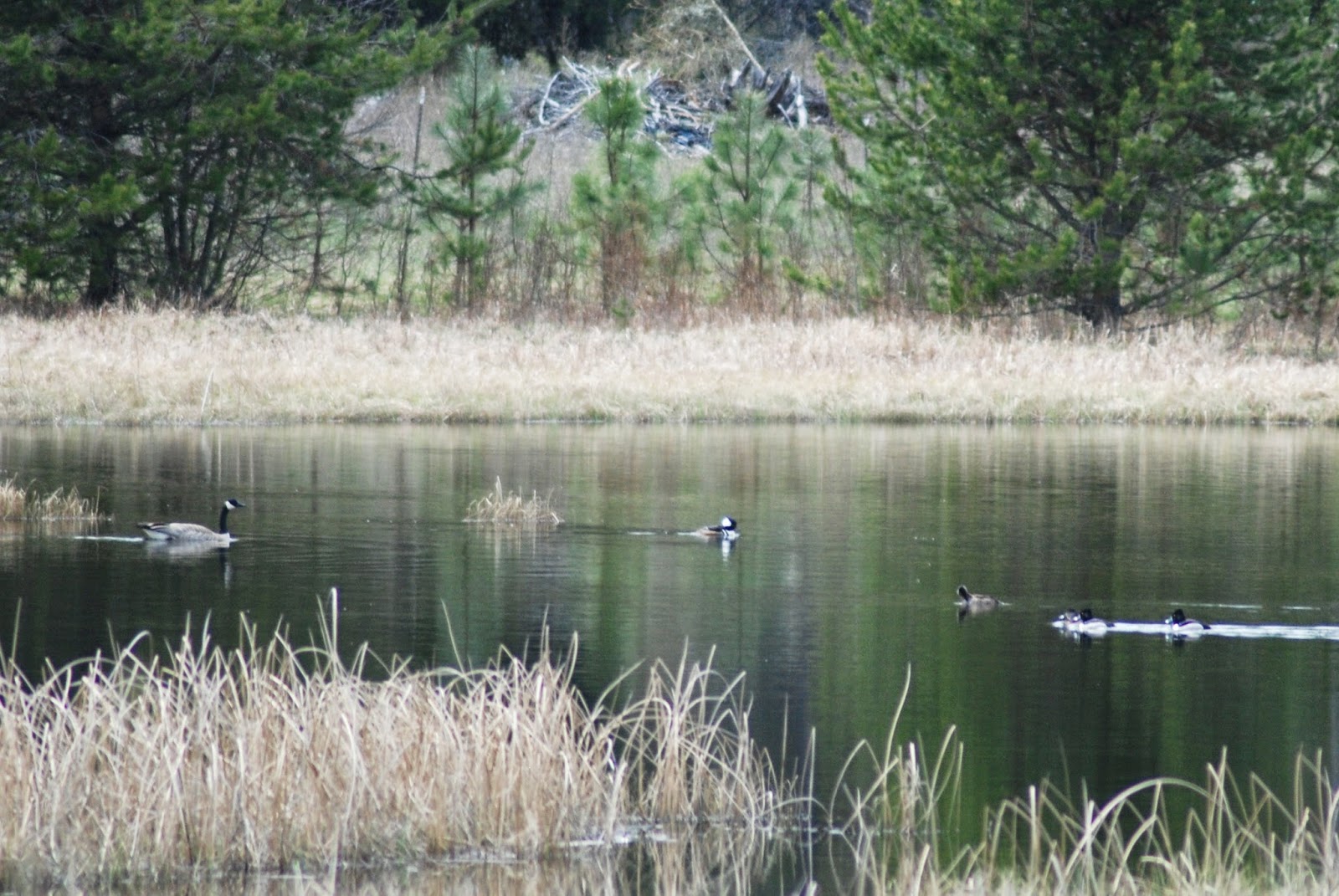
It must be a robust year for pond food to support eight hooded males. The Canada goose couple has returned. At least I like to pretend it is the same couple. They are re-nesting on goose island already. There's one ringed-neck duck couple. No buffleheads or widgeons, yet.

It's early in the season.

But it's the first time I've seen so many flashy white males on the pond. Among them is a single female with her crested mohawk. At least one female likes the potential summer digs and the current menu of food.

Will seven others join in or will seven water-tapping, hood flapping males miss out on spring love? Nonetheless it proves to be a good push into spring. I've missed watching the pond.

The soap opera has begun; March Madness returns with the Magnificent Eight.

Saturday, April 4, 2015

Ghosts in the Mist

Early Morning Mist
Glimpse of White
Mists Blur Identification
Later, It's Clear to See a Bufflehead Couple
Gang of Ringed-Necks
Resident Merganser Couple
The Spring Party Continues
White as a ghost covered in bleached linens, I see movement in the mist. It's early morning on Elmira Pond and the chill in the air creates a shifting opaqueness that hovers and rolls. It blurs the movements of pond visitors, but clearly I see tiny ghosts.

White in April means one thing on Elmira Pond -- the buffleheads are passing through.

Todd stomps dewy grass from his shoes as he enters the house from taking the dogs outside. "Hey, Hon!" He shouts upstairs, thinking I'm still snuggled in the warmth of bed. "Pure white ducks on the pond!"

"Buffleheads," I respond from my window perch.

We argue; the stairs a buffer between one of many bird disagreements we have the way other couples might share breakfast. He can't offer what they are instead, but definitely, they are not buffleheads.

If we ever did see ghosts, I'd see a woman and he'd see a man. Perspectives shift like the pond fog and what we can't see our imaginations fill in the blanks. I'd like to think my imagination is stronger than his, but that doesn't mean I'm right. However, I'm the lurking bird watcher of this pond and I know the buffleheads have returned.

Buffleheads are noted for a large ox-head that sits on their bodies in a disproportionate way. Unlike the ringed-necks that can stretch or mallards with heads propped on elegant necks, this mostly white duck resembles an ox or a buffalo. Thus the name buffalo-headed -- bufflehead.

What this duck lacks in neck grace, the males make up for in elegant colors. His head is iridescent greenish purple-black with a giant white patch that stretches from eye to crown. His body is mostly white with a tapering black back. The females are dull grayish-brown with a distinct white cheek patch that helps identify the males when one's own spouse is in doubt.

I won the duck argument. This time.

Later in the morning, after the mist dissipated beneath the warming rays of sunshine, one male and one female bufflehead slept on the basking log as ringed-necks swam around the pond with vigor. Earlier, I was certain I had seen two males and a female, but now I can only spot the sleeping couple.

The ringed-necks scoot across to the southern end where the hooded merganser couple are paddling. The geese are half-hidden by last winter's dry reeds. The mallards are hunkered down out of sight.

The early morning ghosts have stayed, but for how long? Who will nest and who will fly elsewhere? We wait and watch and welcome two buffleheads to the spring party.

Wednesday, March 25, 2015

March Madness on Elmira Pond


Invite Your Buddies to March Madness
Keep a Comfortable Distance From the Pond
Ready a Chair Under the Apple Tree

So all you NCAA basketball geeks, step aside. Go eat your nachos and have a beer at Sweet Lous,  Laughing Dog Brewery or your own neighborhood pub.

This March Madness is for bird nerds!

Grab the binoculars, camera and the crew. Set up at your favorite viewing spot with an optional beverage of choice (water is wisest, but coffee warms hands on a cool day).

Here on Elmira Pond a chair beneath the old apple tree is best. It isn't too close to pressure timid visitors, yet it is perfect for binocular viewing.

This year I'm inviting my fellow bird nerds to learn about the Big Migrators to or through Elmira Pond. I've tossed in a couple of Wild Cards. "Team Crows" are not migratory, but they take an increased interest of the pond with new visitors. "Team Cat & Crew" are my companions to witnessing the March migration.

A few words about weather in Elmira. Located 17 miles north of Sandpoint, ID and about 45 miles south of the Canada border, we are part of the Inland Northwest and derive enough moisture to grow conifers up to 180 feet tall. We get  six seasons: rainy spring, spring, summer, fall, rainy fall and winter. The two rainy seasons are vital to the forests, valleys and waterways of northern Idaho.

Inland Northwest Courtesy of Wikipedia

Many of the migrators coming from south of Idaho are in serious drought. Rivers are trickles, lakes are dry beds and there's not enough snow pack in the mountains to help with the coming summer. At first I thought our migrators were showing up early because it's been milder this last bit of winter, but it could be that drought is pushing them north at a faster rate.

If you are a backyard birder, leave a comment about what is happening in March where you live, and whether or not you are seeing any unusual activity. Please take time to read the posts linked to each "Team" below and then come back and vote for your favorite.

Team Canada Geese

Team Cat & Crew

Team Crows

Team Mallards

Team Hooded Merganser

Team Ringed-Necks

http://elmirapond.blogspot.com/2015/03/tundra-swans.html
Team Tundra Swans

Team Wigeons

Once you've read about each team, take this survey to cast your vote! Thank you for joining me in March Madness!
Create your free online surveys with SurveyMonkey , the world's leading questionnaire tool.

Team Hooded Mergansers


The Returning Couple
Look Carefully, Both Have Crests
His is Yet Deflated
Diving
She Has a Fish
A Beautiful Pair
Preparing Another Dive
Walking on Water (2014 Photo)
They are back! The mating pair of hooded mergansers -- and I would like to believe it is the same pair, but who knows -- are back in residence.

Supposedly, hooded mergansers are solitary and committed to a monogamous relationship so this could be the same couple that has shown up for the third year in a row.

I think the females will accept another mate if her original one dies. I believe this to be the same female and her male from last year. Let me tell you why I believe this.

2013 was the first year I ever saw mergansers of any kind. In my initial duck-confusion of that year, I thought they were wood ducks because the males have striking features just as wood ducks do and both species use nesting boxes or trees. That year I watched the babies emerge from a tree on the Bluebird Ranch next door to Elmira Pond.

To my horror, an eagle swooped down and picked off several ducklings. I watched with binoculars and yelled at the eagle. The American icon could care less. The male duck got between the ducklings and the eagle, sacrificing his life with that act. The female and two babies survived and kept their summer home on Elmira Pond.

Watching the widowed mother, I wondered at her funny cinnamon-colored mohawk. Turns out that it is a crest and she was not a female wood duck, but a female hooded merganser. She is an impressive fisher, diving and emerging with large fish and even huge bullfrogs. I've watched her rear back her head the same way that I've seen the great blue heron do to swallow a meal whole.

Last year a sole female hooded merganser showed up to Elmira Pond with three males. One remained with her and she had a larger brood of babies last year. Last year we also had a huge increase in red-winged blackbirds. They annoyed me because they often chased off the osprey, and I love watching the osprey. However, they seemed to keep the crows, hawks and eagles away, too. Perhaps this is the security system for Mrs. Hooded Merganser and her second mate.

I'd like to believe that this returning female is her. She has only one male which would indicate their monogamy, as cited in books. But I have to tell you how funny the males are!

They are called "hooded" because the males have a large crest. It inflates and deflates. Just think of other males parts that do so and having something similar on one's head is a rather silly thought. But it is majestic fully inflated. Deflated, it hangs limply like a turkey's baggy glottal.

And hooded mergansers can walk on water! I've seen it! Actually, they can run on water and they do this with their short but powerful wings and their fabulous feet. Last year, I watched a male run the entire length of Elmira Pond.

And those feet and wings are what make hooded mergansers such swift divers. I'm pleased that they have returned and I hope for another brood upon the pond.

This is part of a March Madness Series. Vote for your favorite team!

Thursday, June 26, 2014

Babies & Yellow Roses

Lady Merganser and Brood
Yellow Roses of Elmira
A Celebratory Unfurling
Squinting at the basking log in Elmira Pond, I'm trying to determine which feathered resident has roosted for a rest.

The ringed-neck ducks? Lady Merganser? Or turtles?

Yes, to my eyes, turtles often look fowl. Thus I need the binoculars. Scoping the log I'm surprised to see that it is Lady Merganser with three baby hooded mergansers.

I was just wondering about babies on the pond!

These are not tiny puffballs so I can only surmise that they've been hiding in the reeds. I can't wait to see them diving like their mama.

It's a proud moment, knowing that Elmira Pond has provided shelter for a new generation of mergansers.

As if in celebration, a rosebush unfolded a beautiful butter-yellow rose. Several other buds are showing colorful promise.

Another day and more moments to affirm life is beautiful.

Friday, May 30, 2014

Back in the Saddle

Misty Pacific Northwest
View From the Apple Tree
A Great Blue Heron (Not THE Blue Heron)
Best Grass Mower Around
Male Hooded Merganser
Male Red-Wing Black Bird
Big Basking Turtle
Not Happy to See Me Return
Mist and rain shroud the pond. Like getting bucked off a horse, I'm hesitant to approach. It's a silly feeling, really, but true nonetheless.

I peer through the veil of rain but I can't see anything--no Blue Heron, no ducks. Did they all leave Elmira Pond in my absence or did I lose my ability to see?

The apple tree, my favorite view of the pond is so overgrown, that I stay behind the fence.

Then the clouds part and I climb back in the saddle for a fair-weather ride around the pond and I remember how to see again.

Blue sky, white clouds and a great blue heron flying overhead. Not my Blue Heron, but kin. I haven't lost my sight.

Next, I employ the best mowers in town to crop the grass around the apple tree. It will take a week or two, but the horses will get the grass under control.

Sun shines warm on my face and I sip coffee outside. Really that was all I needed to do--just sit outside. In such moments Elmira Pond comes to life.

I catch movement on the waters that are deep blue today. Two bufflehead hens paddle the shore and two ringed-neck ducks still occupy the waters.

Another sip of coffee and I catch a blaze of white. There's the hooded mergansers! A couple--last year the male was picked off by an eagle so this is a new delight to see a merganser pair.

The red-wing black birds have multiplied. Though I find them annoying neighbors--alarmists--the males are beautiful when they hunch their red shoulders like bodybuilders flexing biceps. They even chase Blue Heron who pops out of the reeds long enough to glide to another patch of reeds.

He ignores the birds and watches for frogs.

I've not heard any bull frogs, yet but at least one big turtle is sticking close to the pond log. Once the bull frogs start up, I'll wonder why I waited to hear them. Loud and proud is their song.

As if not used to my presence, the tree swallows dive-bomb my head. I'm surprised as this is a first.

We all just need to get reacquainted now that I'm back in the saddle, riding over Elmira Pond.


Saturday, April 19, 2014

Day of Reflection

Basking Turtles and Ring-Necked Couple
Busy Day on the Pond
Bufflehead Female
Semi-Inflated Hooded Merganser
Yes! Lady Merganser Has Arrived
Pacific northwest cloud cover, wispy and white nearly hides the blue sky. You can see a tinge of blue as if looking at a robin's egg behind thin cotton. Days like this turn Elmira Pond green.

Not green, as in dingy pond-scum green. This clear water bog pond, peat pond, spring pond, mountain valley pond is many things, but never scummy. Today it is green because of cloud cover. With the blue sky blocked, Elmira Pond reflects the green of the Ponderosa pines.

It's a day of reflection. All six painted turtles line the log with mirror images belly-up to the sky. Basking may not be sunny today, but it is warmer and no longer drizzling. A ringed-neck duck couple joins the turtles in basking.

It's a busy day on the pond. Although the American wigeons vacated over a week ago, the knuckle-headed buffleheads that had courted upon these reflective waters left behind their gal. I noticed the female duck, recognizing her white cheek-patch. Like the mergansers, she roosts and nests in trees.

I'm beginning to understand where ducks go at night.

The hooded merganser inflates and deflates his head while I swill coffee, admiring his colorful pond reflection. I'm delighted to confirm that he indeed has a lady. She's the one doing all the silly head-bobbing, wing flapping and preening that the male buffleheads do. The male floats nearby, puffing his crest.

All are diving, but the geese. The big dabblers are pulling up chunks of submerged plants. Fish or frogs rise dangerously close to divers. I've yet to see a merganser swallow a frog or fish whole this season, but I know they do.

As if in absence of blue, Blue Heron remains unseen. Yesterday he showed up briefly with a companion. I'm hopeful that he may yet raise a family this summer.

Another cup of coffee down and my reflections come to a close.